Beyond snapshots: DNA+RNA, genome‑wide signals, AI and the coming data “Tsunami”
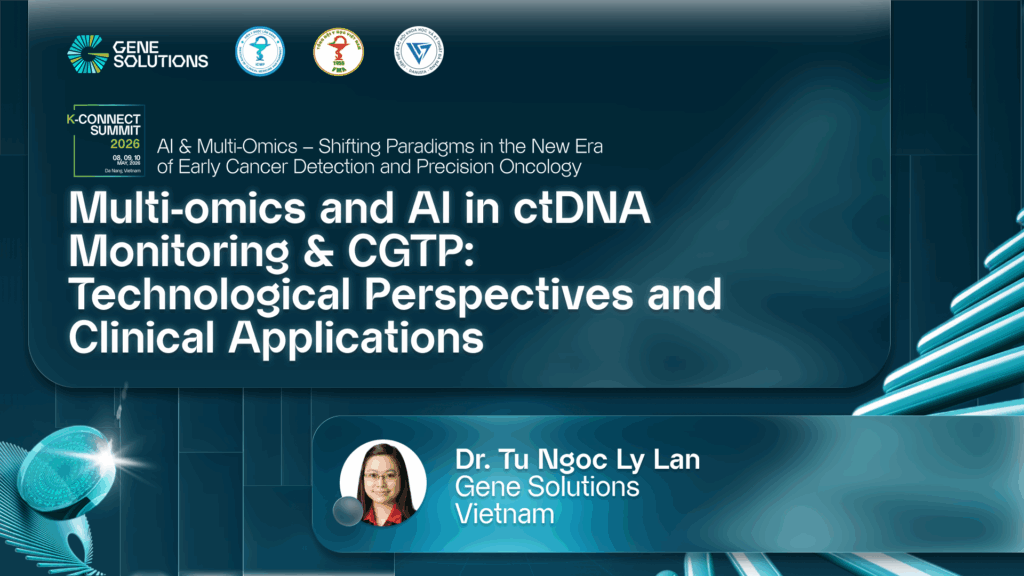
Dr. Lan Tu (Gene Solutions, Vietnam) mapped three fundamental shifts reshaping precision oncology, reflecting the rationale behind the K‑4CARE platform, which integrates comprehensive DNA (tissue and liquid) + RNA (tissue) profiling with ctDNA monitoring.
First, she described the transition from single-gene testing to integrated genomic (DNA) and transcriptomic (RNA) profiling. Because tumors are heterogeneous, broader analysis is essential: DNA detects mutations, while RNA improves fusion detection and provides expression-level insight. Although RNA quality from tissue (FFPE) samples can be variable, this limitation further supports the value of using both approaches together. A recent publication in Cancer Medicine by Dr. Lan and colleagues reinforced this point, showing that combined DNA and RNA analysis improved fusion detection by 20%, improved the sensitivity for detecting MET exon 14 skipping variants, lowered false negatives, as well as provided tissue of origin accuracy of 87.7% for primary tumors and 81.4% for metastatic tumors. and reduces the risk of missed treatment opportunities.
Second, she outlined the shift from static profiling to dynamic ctDNA monitoring. While tissue offers a “snapshot in space and time,” but treatment pressure can change the molecular landscape. Liquid biopsy enables “real time monitoring of the tumor evolution,” capturing emerging resistance and progression signals earlier.
Third, she described a move beyond mutation-centric analysis toward genome-wide, multi-layer ctDNA features—including fragmentomics, copy number alterations, and end motifs—integrated with machine learning to distinguish true tumor signal from background noise such as CHIP. Her point was practical: “It’s not just about mutation. It’s about finding ctDNA signals in the blood, because ctDNA positivity can indicate a higher risk of recurrence or disease progression. These broader genome-wide features strengthen the cancer signal. Supporting data from her team published in in JTO Clinical and Research Reports showed that that incorporating these broader features improved performance, allowing tumor-informed and tumor-naïve approaches to achieve similar sensitivity (86.7% vs. 80.0%) and identical specificity (98.4%) in lung cancer.
Combining genomics with transcriptomics, imaging, and clinical data creates a powerful yet complex ecosystem of information. Dr. Lan concluded by posing a thoughtful forward-looking question: “Are we ready for the data ‘tsunami’?”. She emphasized a pragmatic perspective: while multi-omics ecosystems hold great promise in research, real-world clinical practice demands an optimized balance of breadth, cost, and turnaround time—without sacrificing clinically meaningful biomarker coverage.
<iframe width="560" height="315" src="https://www.youtube.com/embed/6Fqlzp9Etbs" title="Multi-omics and AI in ctDNA Monitoring & CGTP: Technological Perspectives and Clinical Applications" frameborder="0" allow="accelerometer; autoplay; clipboard-write; encrypted-media; gyroscope; picture-in-picture; web-share" referrerpolicy="strict-origin-when-cross-origin" allowfullscreen></iframe>