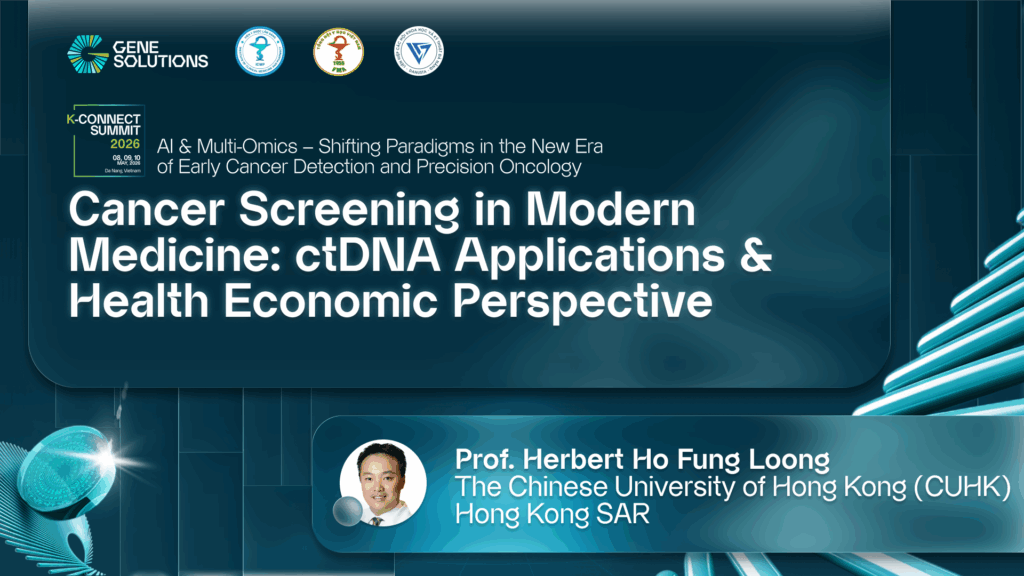
From practice to value: ctDNA applications and health‑economic perspectives in modern cancer screening
Prof. Herbert Ho Fung Loong (The Chinese University of Hong Kong, Hong Kong) shifted the focus from technical advances to macro‑level health economic and societal implications. He emphasized that early diagnosis is not only clinically beneficial but also economically and socially transformative. While patients with many early-stage cancers can achieve 80–90% survival rates, outcomes in advanced-stage disease remain substantially poorer, and late-stage treatment carries markedly higher direct costs and indirect burdens for patients, caregivers and society at large.
He framed MCED as a potential lever to shift stage distribution over time—reducing the proportion of patients presenting with stage IV disease and enabling more curative‑intent therapies. In regions with limited imaging infrastructure, he noted that blood‑based testing may offer greater access and scalability.
His compelling economic perspective was summarized in this quote: “Late‑stage cancer treatment can cost two to three times more than early intervention, underscoring the value of ctDNA‑based MCED in shifting cancer detection toward earlier and more treatable stages.”
<iframe width="560" height="315" src="https://www.youtube.com/embed/SpMgBE9nJB4" title="Cancer Screening in Modern Medicine: ctDNA Applications & Health Economic Perspective" frameborder="0" allow="accelerometer; autoplay; clipboard-write; encrypted-media; gyroscope; picture-in-picture; web-share" referrerpolicy="strict-origin-when-cross-origin" allowfullscreen></iframe>